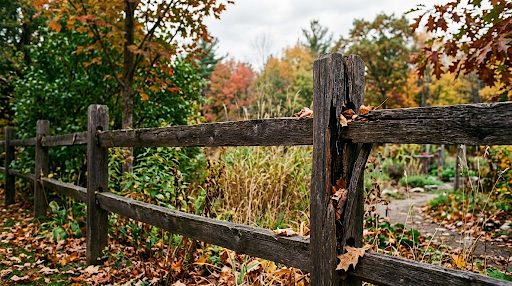
After a long, dry summer, most people are more likely to notice a brown lawn than a problem with their fence. Yet some of the most useful fence repairs I have seen over the years have started with damage that wasn’t obvious until the weather changed. Dry ground moves. Timber dries and contracts. Posts that seemed perfectly solid in August can start shifting once autumn rain and stronger winds arrive.
That is why late summer is a particularly good time to walk around the garden and actually look at the boundary.
Not glance at it from the kitchen window. Look at it.
Give the posts a gentle push. Open and close the gate. Look along the fence line rather than directly at it. Check what is happening where timber disappears into the ground.
A fence doesn’t need to be falling over to be telling you something.
Dry ground can be surprisingly hard on fencing
People understandably associate fence damage with wet winters and storms. In practice, prolonged dry weather creates its own problems.
Soil contains moisture, and its behaviour changes as that moisture disappears. Some ground shrinks considerably during extended dry periods. Clay-heavy soils are particularly prone to movement, which is relevant across parts of Yorkshire.
A fence post is effectively a lever buried in that moving ground.
If the soil surrounding the footing changes, gaps can develop around it. Existing weaknesses in poorly installed posts can become more pronounced. A footing that was already marginal might lose some of the support it had previously been getting from tightly packed surrounding soil.
You can sometimes spot this by looking closely around the base of a post. There may be a visible gap between the soil and concrete, or the post may have developed a small amount of movement that wasn’t there in spring.
A few millimetres doesn’t necessarily mean disaster.
What matters is what happens next.
Autumn rain changes the equation
Very dry soil followed by persistent rain can change condition quickly. The ground takes on moisture, softer areas develop and some soils expand again.
Then the wind arrives.
This is where weaknesses that developed during summer can suddenly become obvious.
A solidly installed fence should be designed to cope with normal seasonal changes, but not every fence has been installed well. I’ve removed enough failed posts to know that what appears above ground tells you remarkably little about what somebody did underneath it.
Sometimes there is plenty of concrete, but the hole wasn’t deep enough. Occasionally you find a surprisingly small lump of concrete sitting just below the surface. Other times the footing itself is substantial, but the timber has deteriorated where it enters the ground.
You don’t discover any of that while the weather is calm and the fence is standing upright.
Wind loading exposes it.
This is particularly noticeable on solid panel fencing because there is very little opportunity for wind to pass through. Each panel catches the wind and transfers that force into the posts.
If one post has started moving, the neighbouring sections begin taking forces they weren’t previously dealing with.
That is how a small weakness becomes several damaged panels after the first proper autumn storm.
Timber itself changes through summer
The ground isn’t the only part of a fence affected by prolonged dry weather.
Timber responds to moisture.
During warm, dry periods it loses moisture and contracts. Boards can shrink slightly, small gaps can appear and timber that was fitted extremely tightly may move. Once wetter weather returns, it takes moisture back on and expands.
Some seasonal movement is completely normal.
Timber is a natural material. Expecting it to remain dimensionally identical through a Yorkshire January and an unusually hot August isn’t realistic.
The distinction is between normal movement and movement that exposes another problem.
Loose feather edge boards, rails pulling away from posts and fixings beginning to work free deserve attention. So do splits developing around fixing points.
This is one reason I dislike seeing fencing assembled as though brute force is a substitute for good installation. Timber needs to be fixed securely, but the person installing it also needs to understand how the material behaves.
Premium timber installed badly is still badly installed fencing.
The ground line deserves more attention than the top
If I could persuade homeowners to inspect one particular part of an older timber fence, it wouldn’t be the panels.
I’d tell them to look at the posts where they meet the ground.
That small area causes an enormous number of failures.
A timber post can appear reasonably healthy further up while deteriorating badly around the ground line. It is an awkward environment for timber because moisture conditions repeatedly change there.
Try pushing the post gently from both directions.
There shouldn’t be significant independent movement at its base.
If the upper fence moves slightly because the entire structure has some flexibility, that is one thing. If you can see or feel the post rocking at ground level, investigate it.
Don’t start aggressively shaking every fence in the garden. You’re inspecting it, not auditioning for a demolition crew.
Small movement is enough to tell you something.
Gates often give the game away
Gates are useful diagnostic tools because small changes become obvious quickly.
A fence panel can move slightly without anybody noticing. A gate only needs to move a little before the latch stops lining up.
If a gate that worked perfectly well in spring has started catching the ground, rubbing against the post or refusing to latch properly, don’t immediately blame the hinges.
Look at the supporting posts first.
Stand back and look at the gaps around the gate. Are they still even? Has one post moved out of vertical? Is the gate itself sagging diagonally, or has the entire opening changed shape?
Those are different problems.
Replacing hinges won’t straighten a moving post.
I’ve seen perfectly serviceable gates unnecessarily replaced because the obvious symptom was treated rather than the underlying cause. A proper assessment of garden gates and their supporting posts can save quite a lot of unnecessary work.
Vegetation adds another load
Late summer gardens can be heavy.
Climbing plants, shrubs and hedges that looked fairly modest in spring may now be carrying months of growth. Add autumn rain and that vegetation becomes heavier still.
If it is leaning against fencing, the fence is carrying some of that load.
I would be particularly cautious with mature climbers attached directly to older panels. They can look fantastic, but a fence panel wasn’t designed to become the structural support for a large plant.
Vegetation also makes inspection harder.
I’ve pulled growth away from fences that looked fine from the garden only to find damaged boards, failing rails and rotten posts hidden behind it.
There is another problem once autumn winds arrive. Dense vegetation increases the effective surface area presented to the wind. A fence that might otherwise cope can suddenly behave more like a sail.
You don’t necessarily need to strip everything away. Sensible pruning and making sure heavy growth isn’t relying entirely on the fence for support can make a significant difference.
Not every defect needs fixing immediately
This matters, particularly while household budgets are under pressure.
Finding a small defect doesn’t mean you need a new fence.
In fact, one of the benefits of inspecting boundaries before winter is that you have time to make sensible decisions rather than emergency ones.
A loose board may need securing.
One failed post might be repairable without replacing an entire run.
A damaged panel between otherwise sound concrete posts may simply need changing.
A slightly misaligned gate might need adjustment rather than replacement.
Equally, there are occasions when repeated repairs stop making financial sense. If several timber posts have failed through rot and the remaining ones are the same age and showing similar deterioration, repairing them one at a time can become an expensive way of postponing an inevitable replacement.
The skill is knowing which situation you’re looking at.
Repairing sound fencing is sensible.
Repeatedly repairing a structure that has reached the end of its useful life isn’t.
Look along the fence, not just at it
One simple inspection trick costs nothing.
Stand at one end of the boundary and look directly along the line of the fence.
Changes in alignment are much easier to see from this angle. A post leaning by a small amount can disappear visually when viewed face-on, particularly if there are plants, sheds and other garden features behind it.
Look for:
- posts beginning to lean or twist
- sections that have moved out of line
- gaps developing between panels and posts
- loose boards or rails
- cracks or movement around concrete footings
- vegetation pushing heavily against the fence
- gates that have changed position
You are looking for changes rather than perfection.
An old fence that has leaned slightly for ten years and hasn’t moved recently may be less urgent than a previously straight post that has shifted noticeably over one summer.
Context matters.
Exposed gardens deserve particular attention
Some boundaries simply have a harder life than others.
Gardens backing onto open land are an obvious example. So are properties at the edge of developments, elevated gardens and boundaries where surrounding buildings create unusual wind patterns.
A narrow gap between buildings can funnel wind with surprising force.
Around Barnsley and the wider South Yorkshire area, there is a mixture of dense residential streets, newer developments, rural edges and properties facing much more open ground. Two gardens only a short distance apart can therefore expose fencing to very different conditions.
This is why I am wary of universal rules about what constitutes adequate fencing.
The right garden fencing isn’t determined purely by what panel somebody likes the appearance of. Height, ground conditions, post specification, exposure and the way wind interacts with the site all matter.
The part underneath the ground is often more important than the decorative part above it.
Don’t wait for the fence to become an emergency
Autumn fence repairs have a habit of becoming urgent because people discover problems at exactly the same time.
Usually after a windy night.
A panel disappears into the neighbour’s garden. A gate won’t close. A post snaps. Suddenly a fence that nobody thought about all summer needs fixing immediately.
Late summer gives you the luxury of avoiding that.
Walk the boundary while the evenings are still light. Check the posts. Look underneath the vegetation. Use the gate. Pay attention to anything that has changed since spring.
You may find absolutely nothing wrong.
Good.
But if the dry summer has exposed a weakness, I’d rather find it while the fence is still standing than have the first autumn gale point it out for me.